
I Guess You Can Teach an Old Dog New Tricks
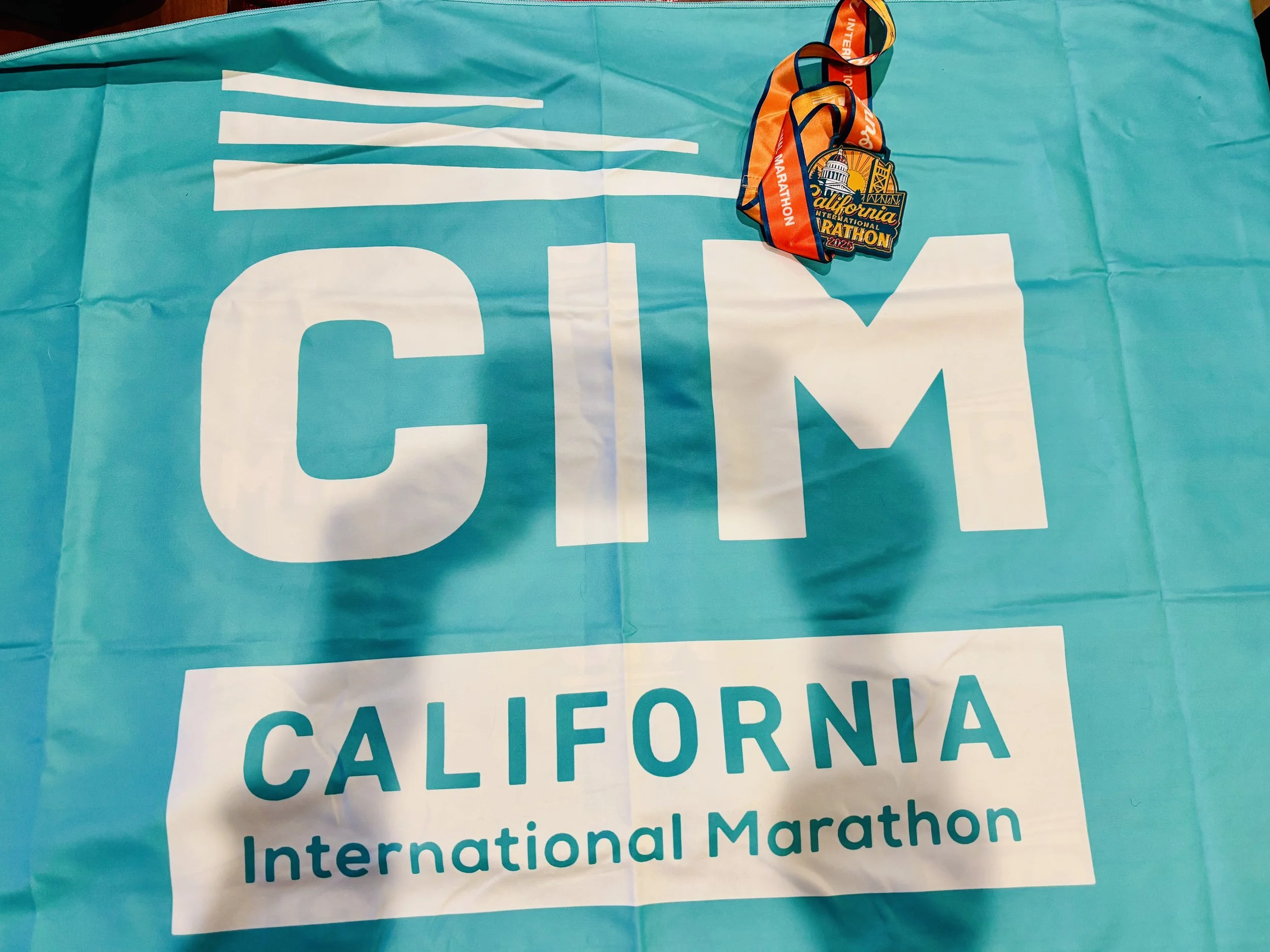
A medal worth keeping
Race Recap + Season Reflection
The night before the race, I focused on three simple goals for CIM: start smart, stay in it, and finish strong.
Yes, the big dream, supported by evidence, was a sub-2:50. But I was clear that I would not let that be the whole story or the only marker of success. I wanted to run with ease, trust myself, and race like the athlete I’ve slowly—stubbornly—become.
And for 25 of the 26 miles, I did just that.
The Collapse
After executing a nearly flawless 25 miles—running according to plan and allowing myself a little slowdown in the final 10K—I entered the final half mile, and my body forgot how to move forward, much less run fast. It was a dramatic blow-up—sudden, complete, and undeniable. Coordination vanished, my legs refused to fire, and I entered that surreal, almost nightmarish space where runner after runner streamed past while all I could do was focus on the next leg lift, somehow putting one foot in front of the other.
I’ve always been able to sprint—relatively, at least—the final stretch of a marathon. This time, I couldn’t. Mike was cheering me on, reminding me, “two laps of the track left,” but it was as if I were in a tunnel: I could hear him, but all I could see and do was move forward, one awkward, trembling step at a time. He took a video just before the last turn where I look impossibly bent forward, moving through jello-like legs, barely upright. At that turn, I was weaving, willing myself to the finish. Hundreds of people must have passed me in those final moments.
When I finally crossed the second finish-line mat, I collapsed. Nothing—absolutely nothing—was left in my legs. Race volunteers, and even an exhausted runner who finished right behind me, offered to help me up, but I could only weakly stand and amble over to the side, lean over the fence, and bury my head, trying to gather the moment and make sense of what had just happened.
And as quickly as I composed myself, all the emotions came rushing in—the overwhelming embarrassment, the sting of disappointment for holding on for so long, only to have no control in those final moments. I cried through the chute. Strong emotion isn’t unusual at the end of big efforts, and in this case, my tears felt like a mix of physical overload and the raw, painful vulnerability of being seen unraveling in a space where I usually try to hold it together.
But as the seconds passed, the weight of those feelings began to shift. Relief crept in first, followed by gratitude—for the months of training that had been up and down, the patience I’d practiced, and the support and love of Mike, driving all over Sacramento to cheer me on at crucial points on course. Then came pride: pride that I had executed my plan, that I had stayed patient and trusted myself through every mile, and that even in collapse, I had finished wholeheartedly.
By the time I walked through the end of the finish line chute, the embarrassment and disappointment had softened into joy and a deep sense of wholeness. I had done exactly what I set out to do—run my race the way I had planned, with patience, focus, and heart. And in that messy, emotional space, I realized that sometimes the most profound victories don’t come in the moments of perfection, but in showing up fully, facing discomfort, and letting yourself feel everything along the way.
Mental Skills That Made This Race Different
Limiting the Noise All Weekend
After the short shakeout run, the mandatory expo visit, and errands to gather what I needed for race day, I finally settled into my “hermit state,” avoiding unnecessary distractions. I binge-watched guilty pleasure TV I’d never watch at home. I ate. I rested. I ate again. And I rested even more. I did the boring things.
Relaxing doesn’t come easily for me—especially when I have unstructured time I’m not used to. At one point, I even asked Mike if I should take an online course I’ve been wanting to do for my counseling practice—just to make use of the rare downtime. Not surprisingly, he (having known me for nine years and fully understanding my inability to truly relax) reminded me that my only job that day was to rest and eat.
Resting my mind is just as important as resting my body. Pacing a marathon demands enormous mental focus, and I cannot afford to waste a single ounce of it. I eventually accepted that it’s the rest—the slow, uneventful, “boring” downtime—that allows me to show up on race day ready to do exactly what I’ve trained to do.
Grounded Self-Talk
Race morning, I wasn’t anxious—not because I’m fearless, but because I had done everything I could. I’ve always been this way: anticipation in the weeks ahead fades by race week when there’s nothing left to do. As the days get closer, I do get antsy, but race-day anxiety is thankfully rare for me.
On the long, dark bus ride to the start, crammed with dozens of anxious runners, I kept conversations minimal and focused on mentally rehearsing the race: when to hold back, when to settle in, when to stay patient. I quietly reinforced my plan, trusting that I had prepared for exactly this day.
Protecting My Energy
I chose carefully who I talked to and stayed away from nervous spirals and over-talkers. Staying calm and grounded—with just the right amount of excitement—is a skill I’ve cultivated over the years, and I protected it fiercely.
Standing Confidently in the Sub-2:50 Corral
Even a year ago, deciding where to seed myself at the start line would have been a mental battle. This used to feel like a place where I didn’t belong.
Not anymore.
I’ve earned the right to line up in a space that feels possible. And so has everyone else—anyone standing there has trained, sacrificed, and come to take their shot. I chatted lightly, wished people luck, and took a couple of deep breaths, feeling right where I needed to be.
awareness and patience
My first process goal for the race was to start smart: let the pace come to me without forcing or pushing beyond what was sustainable. I felt myself surge multiple times, and each time I brought myself back to the same mantra:
Ease. Wait. This should be boring. Don’t push. Let it come.
My pace repeatedly drifted faster than planned, and every time I corrected it—until it finally settled right at the pace Mike had predicted I could sustain for a marathon. Once again, he was right.
Fueling for the Effort I Was Asking of My Body
I took every gel on schedule. No debates, no skipping, no “I’ll grab the next one if I feel like it.” In this training cycle, I’ve learned to override what I think I need and trust the science. When we ask this much of our bodies, we have to give them exactly what they need to show up and perform—a lesson I’ve learned the hard way, repeatedly.
Staying in My Lane
I didn’t chase. I didn’t react. I stayed contained, running my race and not getting pulled into someone else’s plan. Every surge, every temptation to chase, I brought back to my mantra and pacing strategy. This race was mine, not anyone else’s.
Celebrating Small Wins
Every 5K was a quiet victory. Breaking the marathon into eight manageable 5K chunks, plus a little extra, allowed me to stay present and focus on what each segment demanded. Celebrating each block helped me maintain confidence and momentum, mile by mile.
Overcoming My Personal Wall at 18 Miles
This was the point that had defeated me in so many past marathons. This time, I planned for it and arrived at mile 18 with strength and the same calm confidence I had carried through the first 17. Crossing that milestone with plenty of gas left in the tank was a huge emotional victory—a reminder that preparation and mental focus can shift the hardest moments.
Staying Present Under Fatigue
When my pace naturally started to slow, I didn’t spiral. I checked in, accepted the reality of how my body felt, and stayed fully present with what I had. I reminded myself: your legs can keep turning even when your mind is tired. Less than 40 minutes left. Stay in it. Acceptance allowed me to move forward without wasted mental energy.
Allowing Connection to Anchor Me
Seeing Mike three times on the course anchored me. He’s been with me throughout this process—the ups, the downs, always in my corner. Feeling his presence, love, and support gave me a tangible boost and reminded me I wasn’t alone. Letting that connection fuel me instead of distract me was a deliberate choice.
Feeling Everything, Fully
After the race, every feeling came flooding in—the embarrassment, the sadness, the fleeting self-critique, followed quickly by pride, gratitude, and joy. None of it was wasted. All of it belonged. Letting myself feel everything, fully and without judgment, closed the race in a way that honored both the effort and the journey.
What I Learned This Season
This wasn’t a perfect cycle. I had many solid, strong runs—and I also faced setbacks: sickness, fatigue, life stress—all the normal challenges of training as a parent, a therapist, and someone juggling a full life, not a full-time athlete with the luxury of singular focus.
And still, I hit the goals that mattered:
I raced with patience.
I trusted myself.
I ran with ease until I couldn’t.
I stayed in it when it got hard.
I finished with heart, even if not with grace (finish-line collapses rarely are graceful).
And yes—I set a PR at 48.After running at least 65 marathon. Good things take time.
It’s not that I suddenly learned it’s not all about outcomes—I’ve always found joy in running. But when I’m pursuing a really hard goal, I can slip into being overly fixated on times, and that never serves me. This race was about creating space—letting myself be curious, grounded, and open—while still doing the work an ambitious goal requires
The sub-2:50 dream is still alive for next summer or fall. I have about 100 seconds to whittle away, and I know I can do it. But this race rewired the way I approach goals: instead of holding so tightly to a particular outcome, I learned to invest in the process—the mental skills, the boring choices, the confidence that can ride out the inevitable lows in all phases of life.
I wanted to prove that change is possible at any age—that you really can teach an old dog new tricks.
Turns out, you can.
And I did.
