
The Final Stretch: Trusting the Work Instead of Chasing More- 2 weeks out
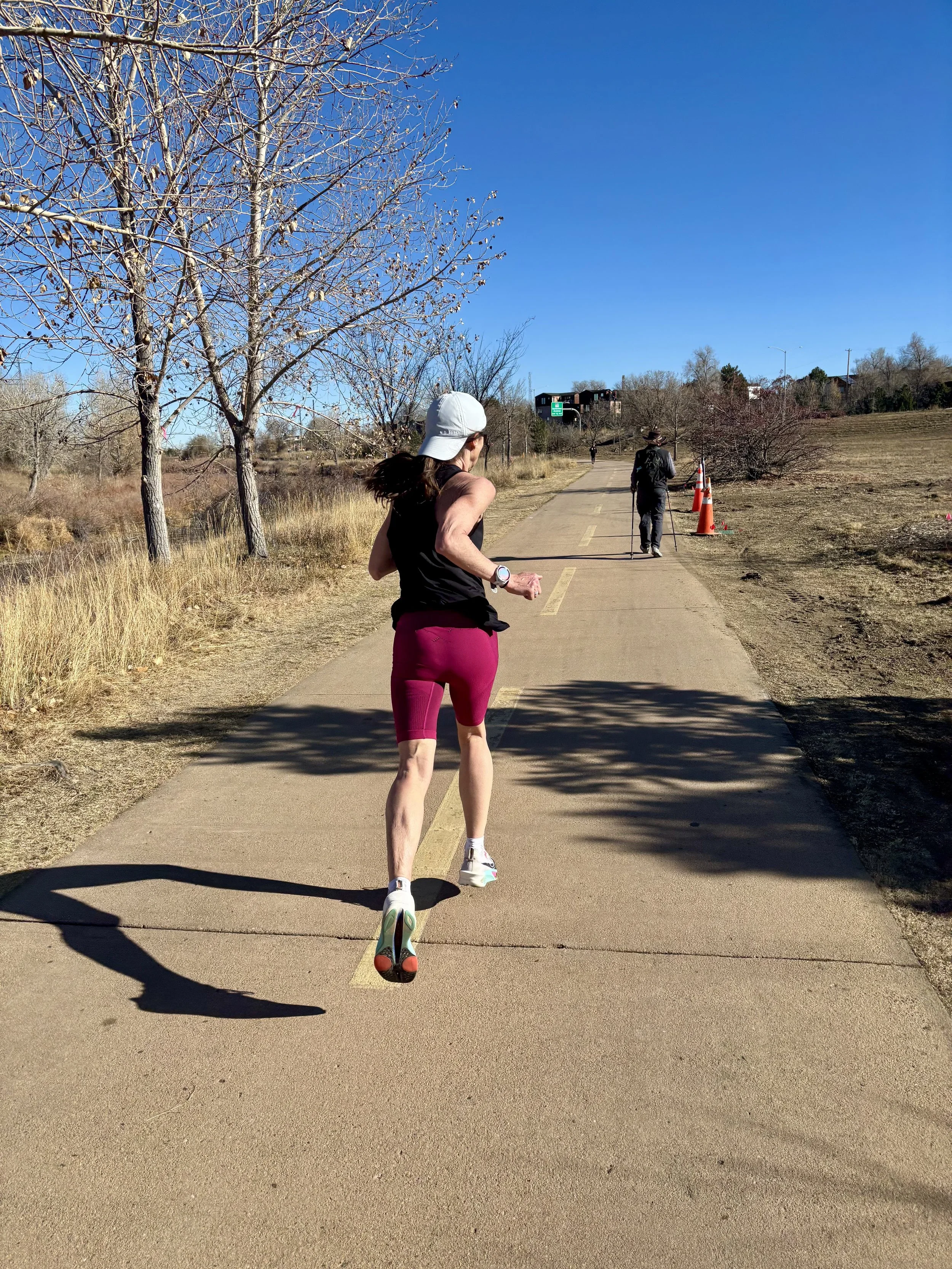
Last long marathon paced run
Slow to post this one with only five days until the big dance—but the lesson in it is one I’m still practicing as the countdown continues.
the space between building and tapering
The stretch before your goal race (in my case, CIM) is a strange space in training. You’re close enough to feel the race approaching, but not quite in the calm of taper. Every workout suddenly feels like it carries extra weight. The fitness is mostly built, the sharpening has begun, and the mind starts searching for certainty wherever it can. And in this window, the mental layer of our fitness becomes just as important as the physical.
It’s often said that you can ruin a race in the final two weeks by doing too much—but I think you can just as easily derail it by neglecting the mental work. This phase asks us to prepare our minds for everything the training cycle has brought: sickness, delays, pivots, unexpected challenges, or simply the normal ebb and flow of confidence. The goal now isn’t to create more fitness. It’s to keep your mind steady enough that the fitness you’ve built over months can do what it’s designed to do—without interference, urgency, or doubt getting in the way of how your race naturally unfolds.
A Mid-Week Run That Taught Me Something
Two weeks ago, I found myself right in the middle of this tension. I headed out for my usual mid-week 90-minute run—the one I’ve hit consistently for three months. But because of a morning appointment in Denver, everything shifted: flatter terrain, late morning instead of pre-dawn, and slightly lower elevation. I was finally feeling more like myself after weeks of lingering sickness and still processing a half marathon that hadn’t given me the clarity I wanted.
Somewhere in the middle of that run, a familiar urgency crept in:
I need to prove I can still run fast.
I didn’t realize it until the last ten minutes, and by then the run had already shifted. I wasn’t letting it unfold—I was trying to control it. That subtle change in mindset altered the entire tone of the run in a way I never intended. There was absolutely no need to press. The terrain alone made the effort feel easier. But I nudged the pace anyway—not dramatically, just enough to finish more drained than I should’ve been. This time, at least, it didn’t take long to see what had happened and how easily I can slip back into patterns I’ve been working hard to recognize and change this cycle. I’d let emotion dictate the run instead of the plan. And even after all these years, it still frustrates me how quickly that urge can creep in when I lose sight of the intention.
how it played out in my long run
Just a few days later, during my final marathon-pace long workout, I hit every pace I needed to. But the run didn’t feel as fluid or settled as I wanted. My legs were fine; it was my mind that felt all over the place. The urgency from earlier in the week was still there—a quiet lack of trust in what I’ve already built.
Even with Mike on the bike pacing me, handing me fluids, and encouraging me, I kept drifting too close to his wheel, unable to let the pace settle naturally. I couldn’t find that smooth marathon rhythm I’m aiming for at CIM, no matter how many times he reminded me to “back off and let it come.”
It wasn’t until the final effort that I finally exhaled, let go, and ran the way I needed to. I finished strong, but more spent than ideal. And even though I wished I’d executed differently, the lesson was familiar: patience, trust, and noticing how quickly emotional patterns can hijack performance—even when we think we’re prepared.
Notice It, Shift It — Why Awareness Matters
The difference this time is that I’m more aware of these patterns than I’ve ever been in past cycles. Working with a sports psychologist over the past several weeks has helped me recognize the habits that surface when I care deeply about a goal—especially that instinct to prove something to myself. Years ago, it might have been about proving something to others. Now the urgency is more subtle: proving to myself that I can still handle the hard work, even with age, surgery, and life stress in the mix. But that pressure never helps. It always gets in the way of true performance.
A long, consistent block builds tremendous confidence… until illness shakes the stability of it. When the body feels off, the mind starts searching for evidence. In my own practice—and in the work I do with athletes—simply noticing that urge is often enough to weaken its pull. Psychology calls this cognitive defusion: observing a thought without automatically acting on it. It’s simple and surprisingly effective. It helps with cravings, intrusive thoughts, irrational fears, and it’s incredibly useful in performance settings—where clarity matters just as much as fitness.
And I’m fortunate to have a coaGch (who also happens to be my husband) who keeps reminding me of the basics I tell athletes all the time:
Be patient. Trust the work. Let the plan lead. You can’t force fitness to reveal itself.This Phase Can Feel Tricky
Even with a solid plan, certain patterns tend to show up in this window:
Testing tendencies — not because fitness is lacking, but because uncertainty gets louder.
Emotional carryover — an off-feeling run bleeds into the next.
Urgency to “check” fitness — especially after sickness or a race that didn’t go to plan.
Trying to verify instead of trust — a completely normal human response to stress.
These aren’t flaws. They’re signs that you care. And awareness—not perfection—is the real work.
Ways I’m Staying Connected to Patience and Calm
Reflection after each run
I write down what went well, what showed up mentally, and what I want to adjust. Research shows this kind of reflection strengthens self-regulation and helps athletes maintain more stable confidence—so one shaky workout doesn’t throw the whole week off.
Micro-routines
Hydration, eating, sleep, and true recovery.
Simple, repeatable controllables calm the nervous system and create steadiness when emotions spike.
Support from a coach or training friend
Checking in when the “prove-it” energy rises provides perspective. Social support is one of the strongest predictors of resilience in endurance athletes.
Intention setting
Before each run, I ask: What is the purpose of this workout? Intention keeps my effort aligned with the plan—not with doubt, insecurity, or urgency.
Focus for the Final Stretch
You’re not fully in taper yet, but this phase is all about nuance. The emphasis now:
— Notice tendencies, and choose trust over urgency.
— Let the plan guide your effort—not emotion or doubt.
— Run relaxed, not reactive.
— Protect mental freshness; emotional fatigue is often more costly than physical fatigue.
— Stay curious instead of judgmental—curiosity keeps you open, not tight.
— Trust what’s already built.
final thoughts
These final days are about alignment: running the workouts as written, listening to my body, and resisting the urge to create tests I don’t need. Between my coach’s reminders and my sports psychologist’s guidance, I’m staying focused on the work that matters—not the noise that doesn’t.
These last days aren’t about proving anything.
They’re about arriving at CIM grounded, ready, and connected to the fitness I’ve built over months—not just the last few weeks.
And perhaps most importantly: allowing that fitness to unfold naturally, without the mind stepping in to push, distort, or force what’s already there.
