
The Mind Games of Tapering
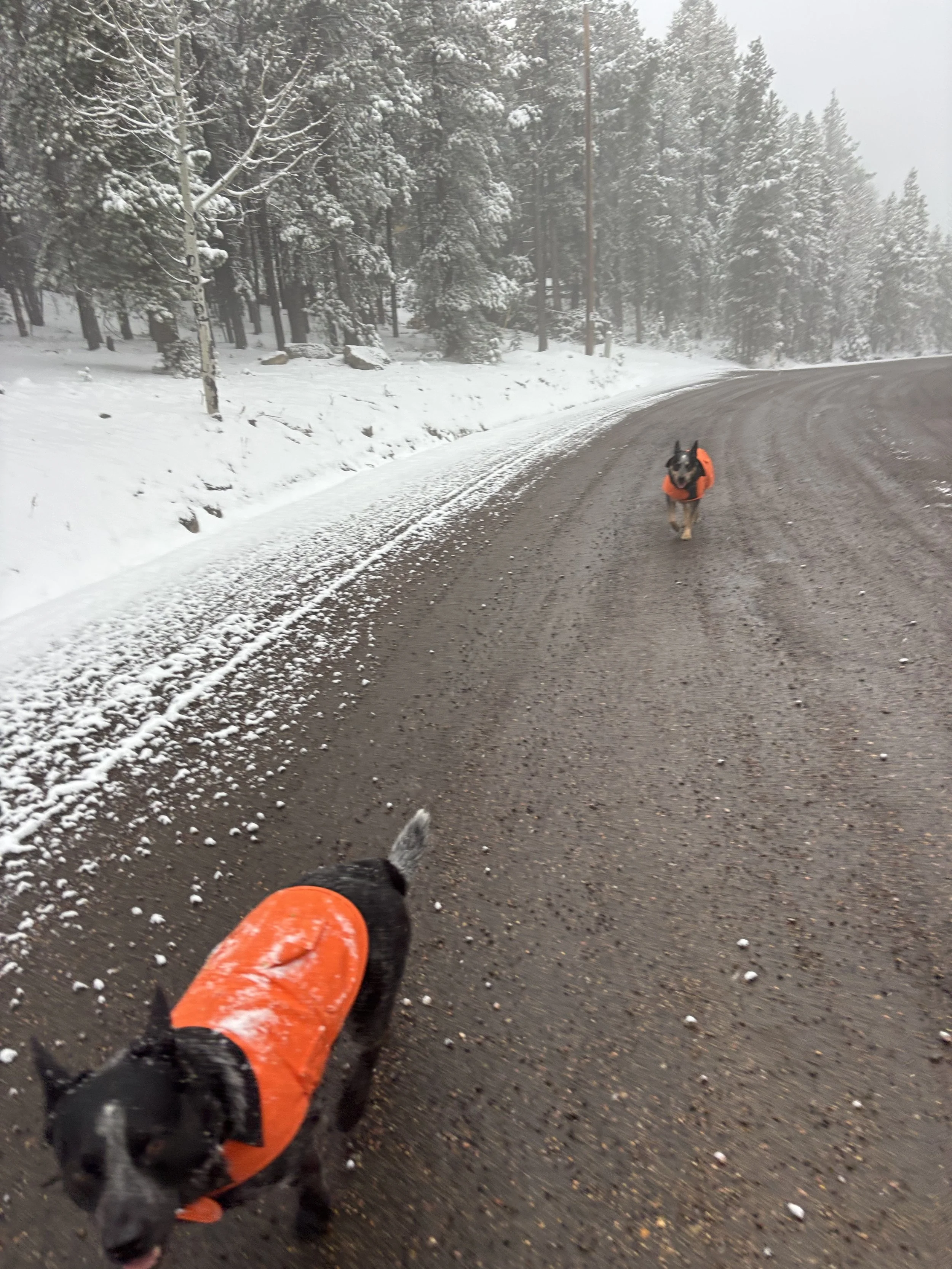
Left the watch alone. Took the dogs out in the snow. Just ran
Tapering always messes with me, that strange slowdown in training that starts a week or two out from race day. I have a friend who says his favorite parts of the training cycle are the taper and recovery. Recovery, I can get behind, as usually I don’t have a choice, as I'm exhausted, and things feel complete. But the taper is an interesting beast, and after over 20 years of doing this stuff, I still don’t know how to do it well.
If you are working towards goals that are meaningful for you, it is expected that there will be many moments in a training cycle where things will and should feel hard.
Those workouts where you are aiming to hit splits that seem a little out of reach. The tempo runs where you start out with whispers of doubt and thoughts like “Can I hold this?” and you lean in anyway.
Those times in training are expected, and I do not fear or dislike them. I actually look forward to them as I have learned over the years that when I am trying to do hard things, it will be hard, and I welcome the curiosity and the chance to stretch what I am capable of.
Similar to how I feel during the bulk of the hard work part of the training cycle, I also feel calm and as confident as I can be on race morning.
From working with my clients and being around my friends, I know race morning often brings a specific kind of anxiety. I feel lucky that I most often can head into those mornings breathing out, knowing all is done. There is nothing left to squeeze in, no extra workout or recovery hack that is going to change anything.
All that’s left is the thing that got me into this in the first place. Running. With a body I have trained and a heart that is excited to see what the day might hold.
On the bus to the start line, hearing runners recap their training, quietly listening to people share their doubts and hopes, I can finally relax a bit. I think about the months of early mornings getting up to train before the second part of my day starts, getting tired teenagers out the door which most days feels harder than the workouts.
Standing in a start corral surrounded by a sea of runners who have all quietly and consistently done the same thing for months, it’s a feeling that is hard to explain. Excitement, nerves in a good way, and just a sense that whatever happens, I will do what I can with what I have that day.
Those parts of training, the grind and race day, don’t really create anxiety or doubt for me. They feel expected.
The Space In Between
What throws me for a loop is the space in between.
That stretch when tapering starts and things come to what feels like a standstill, at least training-wise, while life keeps going at the same pace.
I’ve never known what it feels like to do this running thing as a job, but this is the part I imagine would feel very different. Real recovery. More sleep, less expectation, less noise. A space to honor the work that has been put in.
That is not the reality of being a full time therapist and a parent and someone with two high energy dogs that still need to get out twice a day. Or for many of us who love to spend our free time doing this kind of stuff.
This end of the school year stretch is its own kind of marathon.
And it’s a marathon on tired legs that have been going since late August.
Finals are coming up, kids are worn down, sports are still going, and if you are on top of things, you have already planned most of the summer.
These are good things. And they can still feel like a lot when my own tank is getting low.
So when I’m in this taper space, it’s not just about running. It’s life moving fast while I am trying to slow down a little. I wouldn’t trade those roles I get to carry, but it does make this part harder, especially at the end of a school year when everything seems to pile up.
The Noise Gets Louder
Tapering is tricky, as intellectually it seems like your body will finally have the time to adapt to the hard work, and you will have the chance to settle into feeling rested and calm. This feels far from my reality, and from many I spend my time talking with.
When the volume drops and the structure loosens just enough, there is now space to notice things, think about things you didn’t have time to before, and start questioning all of it. Stress is stress, and life stress doesn’t care that you’re trying to ground yourself for a big effort that requires so much physically and mentally.
Every signal your body sends suddenly feels louder, and it’s easy to start assigning meaning to all of it.
And of course, the noise often blurs things.
It makes sense that fatigue feels heavier, niggles feel more significant, and everything might feel a little off.
Because it’s not just physical.
The Data Layer
This time around in my own taper for my race this coming weekend, there has been another layer in the mix. Data.
Wearable devices I have worn around the clock for years. They track heart rate, sleep scores, and predict training times. I know they are not to be blindly trusted. I still have a love-hate relationship with them. But I do look at them and take note of patterns that show up.
Heart rate data, recovery suggestions, subtle nudges to slow down, back off, and question whether I have done too much.
Am I getting sick? Is my heart ok? What do I actually need to pay attention to here?
I have never been one to rely too heavily on predictions because they have often underestimated my performance, and that’s the last thing you want when you’re getting ready for a big goal.
Last week, I went down that path more than I would have liked. Looking into it more, asking questions of my doctor friends, trying to make sense of it.
Once that doubt got in, my body followed.
My anxiety spiked, runs felt harder, I found myself checking my watch more, and every sensation started to feel like confirmation. You’re overcooked and done.
And just like that, I had a full story built.
This easy run feels harder than it should.
My heart rate is higher than normal.
I’m more tired than I expected to be.
Life feels heavier right now, too.
That’s the spiral.
Before long, the questioning turns into a firm belief that something must be wrong. I even started thinking it might make sense to not even line up for the race.
Eventually, at the advice of my husband/coach—who has seen me go down this path enough times now, and also knows it from his own experience running professionally—I decided the best thing to do was just back off a bit and see what happens. Eat, sleep, and remove as much noise as I can to give myself the chance to let things settle.
The In-Between
This part of the training cycle isn’t very clear. There are big workouts to anchor you. No race day energy to carry you.
Just more space than you are used to.
And in that space, everything feels a little louder.
Fatigue stops feeling like a normal response to training and starts feeling like evidence.
What I have to continually remind myself of, even when I don’t fully believe it in the moment, is that nothing new is being built right now.
This isn’t the phase where you gain fitness. It’s the phase where everything you have already done starts to settle in.
There’s no immediate feedback here. No clear sign that you are on track.
Just sitting in the uncertainty a little longer than you’d like and trying not to turn it into a story, as that is what can happen in this space. You have just enough information to start building a narrative that begins to feel very real.
When really it’s likely normal training fatigue, imperfect data, life stress, and a very human tendency to try to make sense of it all.
And after over 60 marathons, I’m still learning how to be in it.
This phase of tapering isn’t just about pulling back physically; it’s about holding steady mentally when there’s less to grab onto. Reframing what you are doing and why, and working with yourself to not lose sight of those very important things.
Not every part of a training cycle is meant to feel strong and certain.
Some parts are meant to feel like this.
And the goal isn’t to eliminate the doubt, as I'm not sure that is possible. It’s to acknowledge it and not to attach so much meaning to it.
Because we don’t suddenly lose our fitness in a week, we just stop trusting it for a bit.
Yesterday
Yesterday, the morning after a really insightful session with my own sports psychology coach, I wore the watch but didn’t look at it once, took the dogs out in the fresh snow before school and work, and just ran. It was the best run I’ve had in ten days. It felt like coming back to myself a bit. To quiet the noise, I had to catch myself in the spiral, make adjustments, and just do what I do. Run.
I’m writing this three days out from my marathon. Doing my best to trust what I’ve already done.
balance in coaching
Recently, I’ve felt genuinely hopeful and encouraged watching something different as a sports parent.
Coaches who show up with balance.
Firm expectations.
Clear standards.
An understanding that athletes should bring effort, focus, teamwork, and a good attitude.
But alongside that — steadiness and consistency.
Teaching. Investment. A commitment to developing skills that extend far beyond how someone performs on a basketball or volleyball court.
Today at my daughter’s new volleyball Youth Development practice, I watched this balance play out in a simple but powerful way. Her young coach used three consistent words to help these eager athletes reset and stay in it when things didn’t go their way.
An athlete stretched for a ball that was just out of reach and missed.
Without hesitation, the coach tossed another one to a similarly difficult spot on the court.
“Try that again,” she said — calm, steady, encouraging.
No visible frustration.
No sarcasm.
No rushing in to fix it for her.
Just another opportunity.
And she did this throughout the entire practice.
This wasn’t a one-time correction. It was her method.
Miss it.
Adjust.
Go again.
Improve it.
At one point, my daughter missed a ball that looked very playable. I saw the brief flicker cross her face — that internal recognition when we know we’re capable of more. It’s an uncomfortable moment, one most of us would rather avoid.
Her shoulders dropped slightly as she looked to the floor for a brief pause before she steadied herself.
From the sidelines, I heard that same calm, encouraging voice again: “Try that again.”
My daughter stood a little taller, took a breath, and went after it — this time with more strength and focus.
That response is what we are really training.
Confidence Is Built in the Response
We often associate confidence with success. While success can certainly build confidence, it is also shaped in the space between the miss and the next attempt.
Confidence grows when we don’t spiral after a mistake, avoid the next opportunity, or allow one miss to become a permanent story about who we are.
A steady “try that again” communicates belief.
It says:
You are capable.
This is part of learning.
When we stay engaged, we internalize that showing up and continuing to strive is what supports development and mastery over time.
That combination — experiencing progress, receiving feedback, and learning how to respond to setbacks — builds mastery.
It also shapes identity.
As Michael Jordan said:
“I’ve failed over and over and over again in my life. And that is why I succeed.”
The choice to try again
This applies far beyond youth sports and athletic performance alone.
It’s about the runner training to complete their first race without walking and discovering that some workouts feel harder than expected.
It’s about the competitive athlete chasing something specific, like a sub-3 marathon, and learning that progress is rarely linear.
It’s about applying for the job that feels just slightly out of reach.
It’s about being willing to have the hard conversation when it matters.
Starting therapy.
Choosing to take an honest look at patterns that have been getting in the way of the life or performance you want.
It’s about deciding to stay engaged with something that matters even when it would be easier to walk away.
Every time we miss, we have a choice.
We can protect ourselves by stepping back.
We can decide it’s safer not to try again.
Or we can adjust and step back in — knowing we might miss again.
Avoidance protects our ego in the short term, but rarely supports long-term growth.
Trying again is one way self-belief and mastery are developed.
Sometimes you try again… and you still don’t get it.
And then you try again.
I used to think of this quality as stubbornness, and sometimes that is what keeps us showing up long enough to figure out how to do something.
But I believe it is something deeper — a belief that we can learn, grow, and change by choosing to do something differently than we have before.
If you’ve missed lately — in training, in work, in parenting, or in the expectations you hold for yourself — you are not defined by that moment.
The question isn’t whether you missed.
The question is what you do next.
Take the breath.
Try that again.
Growth rarely comes from getting it right the first time. Most high performers I’ve spoken with describe their goals as unfolding over years of sustained effort, adjustment, and persistence — not a straight line, but a long process of learning and becoming.
It comes from staying in the arena long enough to learn, adjust, and keep moving toward what matters.
If fear of missing is keeping you from stepping toward something meaningful, I hope you’ll treat that feeling as important information — not as evidence that you are stuck.
Sometimes it’s simply about choosing to try again.
It’s about staying in the arena long enough to learn, adjust, and keep moving toward what matters — even when it is uncomfortable, uncertain, or imperfect.
