
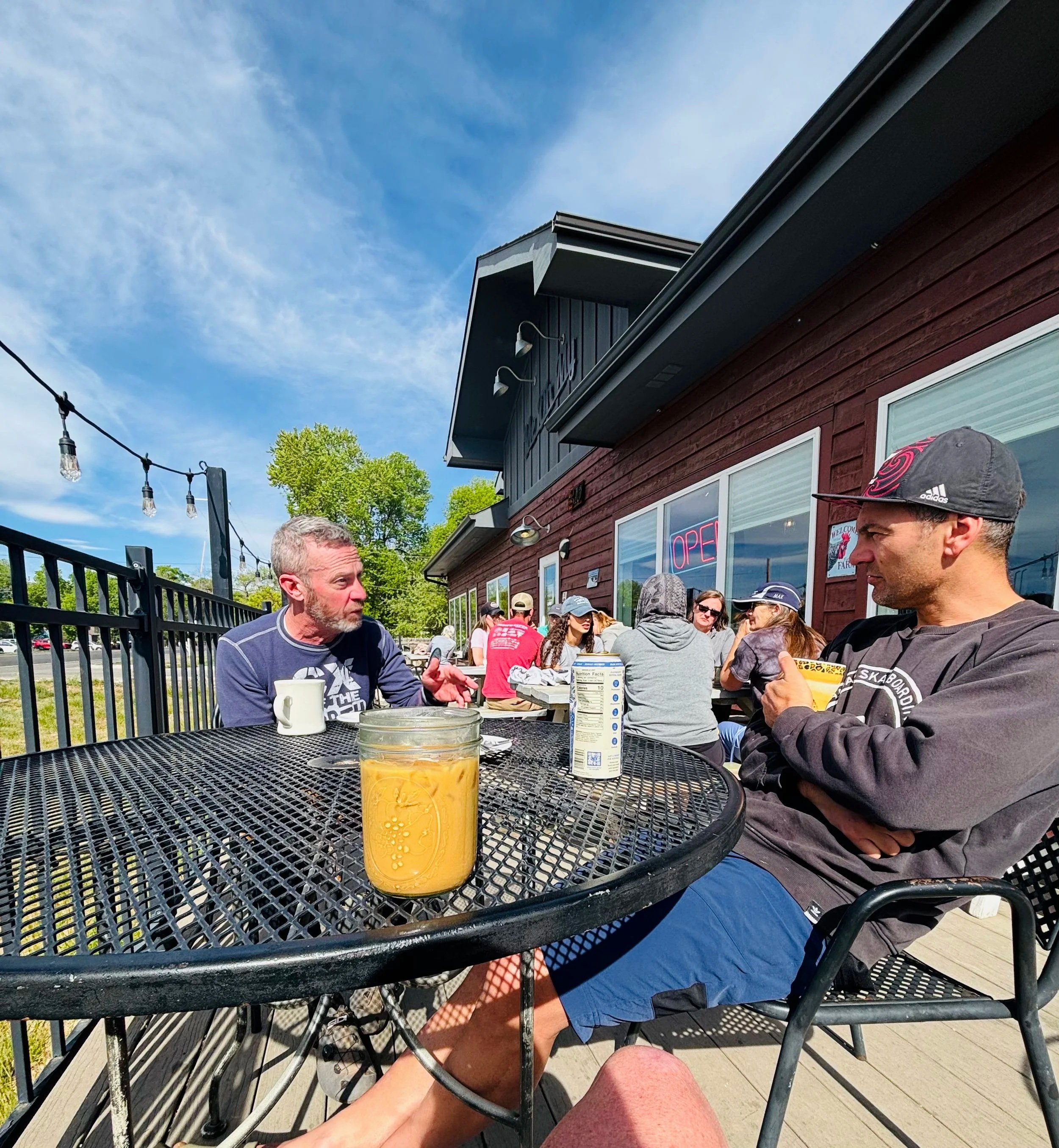
Coffee and Pie at Mile 21 with Mike and Tom
The Taper
Days before lining up at the Colorado Marathon, I was trapped in the strange, hyper-aware mental space of the taper. I was tracking elevated heart rates, battling unexpected fatigue, checking wearable data that didn’t match my expectations, and trying desperately to sort out normal training noise from something more serious.
In endurance sport, we’re constantly living between two ideas that don’t always agree: listen to your body AND push through discomfort. Most of the time, that tension is exactly what training is built on.
After a solid training block, I was still planning to race and trying hard not to read too much into every signal my body was sending.
Race weekends have always felt like a rare gift to me. It is a stretch of time where life narrows down to something so simple after months of juggling work, parenting, training, schedules, dogs, cold mornings, and everything else life holds.
Eat, rest, run a little, eat more, let the work soak in.
I was excited for this race weekend to feel that way, too. But in the weeks leading up to the race, things never fully settled.
The taper was probably the hardest and most confusing I’ve had in over twenty years of marathoning. My heart rate was sitting alarmingly higher than normal, I felt unusually fatigued, and the more I noticed things, the louder everything became.
A couple of days before the marathon, I met with my sports psychology coach to talk through how I wanted to approach the race. We talked honestly about whether it even made sense to line up with all of the unknown health stuff, the elevated heart rates, and a level of fear and anxiety that normally isn’t part of my marathon buildup.
In the end, to no one’s surprise, I decided to run anyway.
Things did not feel resolved or certain, but I wanted to stay open to seeing what might still be possible underneath all the noise. Earlier in the training cycle, when all seemed to be flowing well, the Colorado Masters women’s record had started to feel like a tangible goal. By race week, though, I chose to loosen my grip on that completely.
I knew I was trained and prepared to go after it physically. Mentally, I had gotten myself into a place where I could stay open and curious about the day instead of attached to any specific outcome.
Apparently, my body had other plans.
Early Miles Surprise
The Colorado Marathon holds a special place in my running history because it was my first marathon back in 2003. I ran it side by side with a coworker, thinking it would probably be a one-and-done bucket list experience.
Clearly, that wasn’t how it turned out. Here I am today with at least 50 of these things behind me, still finding races to get excited about and goals to aim for.
Despite all the uncertainty leading into the race, I still wanted the chance to experience the day and see what I could access after months of work. The weekend itself was quiet and familiar—some much-needed slowdown time with Mike, doing what we’ve done so many times before on these marathon weekends.
Race morning started like most of them, and I felt calm, quietly excited, and ready. I had slept well, eaten well, and for the first time in weeks, my stress levels felt lower. Maybe too little, too late?
I stood on the start line, not thinking too much about pace goals anymore, but excited to run. I introduced myself to Tom, the lead bike pacer, and after the gun went off, he settled in right behind me while I settled into my early effort leading the women’s race.
By mile 2, things already felt off. Not dramatically bad. Just harder than they should have been.
Anyone who has raced enough marathons knows the early miles should feel restrained and really test your patience. If I'm running smart, I am focused on holding back and settling in. This didn’t feel like that. Each mile felt like work.
I glanced at my pace occasionally and noticed I was running slower than expected based on my training, but I kept trying to relax into it without forcing anything. I did all the usual things I’ve learned over years of racing when effort starts to feel just slightly out of reach: relax my shoulders, loosen my upper body, remind myself of simple mantras I have cultivated over the years, take gels early, and problem-solve whatever I could.
None of it helped, and my perceived effort never changed. I felt rigid. Like I was forcing the run instead of doing what I’ve worked so hard to learn over the years: letting it come to me.
By mile 9, I reluctantly—and now thankfully—looked down at my heart rate screen.
It was hovering around 200.
I didn’t immediately stop because that’s not what endurance athletes are trained to do. But there was a very deep knowing that my race was over.
I asked Tom, the bike pacer, if he had a phone because I wanted to call Mike. I already knew what I should do, but there is something about facing a DNF in real time that makes you want someone else to say it out loud. Tom let me know there was no cell service in the canyon for several more miles.
When I told him what my watch was showing and shared some of my recent history over the past couple of weeks, his calm and quiet presence shifted immediately. He asked me to stop, checked my pulse manually, and confirmed what I already knew.
My heart felt like it was beating out of my chest.
We stood for a minute on the side of the canyon problem-solving before I made the only decision there was to make and called it for the day. And just like that, I found it incredibly easy to let go of the competitive part of the day.
I have a few DNFs on my resume, and all of them have involved significant reasons to stop: a broken bone, ferritin in the single digits, severe plantar fasciitis that impaired every step, illness, and antibiotics completely shutting my body down.
And now this. My first road marathon DNF because my body was loudly telling me it was no longer safe to push anymore.
I don’t judge people for stopping when a race stops making sense for them, but for me, it has always been a very hard call to make.
Stopping. Pulling the cord. Letting go of the day you thought you were going to have.
But when it becomes very clear that continuing is no longer the right decision for your health, the choice becomes simple very fast.
As runners passed me, I barely noticed them. My focus narrowed completely to taking care of myself and figuring out what was happening. Tom and I decided I would slow way down, monitor my heart rate, and keep moving toward phone service so I could call Mike and make a plan from there.
I didn’t walk because physically I didn’t feel like I needed to. Once I backed off to an easy run, my body settled, and my heart rate, while still elevated, no longer seemed dangerous.
The pace shifted from racing to something that felt more like an easy long run with a new friend.
Running With a New Friend
By mile 16, we finally hit cell service. Tom called Mike for me, and we paused briefly so I could speak to him.
The second I heard Mike’s voice, I burst into tears.
Writing this now, almost three weeks later, it all sounds calm and methodical, but in the moment, it absolutely wasn’t. Two hours of fear and uncertainty immediately made way for uncontrollable tears. Mike had already assumed I’d stopped racing when he saw the timing splits, and he was on his bike trying to figure out how to get to me on course.
As we eased back into a jog toward mile 21 to meet him, the run slowly started to take on a completely different feel. I high-fived aid station volunteers, cheered for runners still racing, and found a steadier rhythm where I could finally relax again.
Tom and I talked about everything—Leadville stories (he had done the bike 100, and I’d done the run), parenting teenagers and young adults, injuries, aging in sport, race reports, messy life chapters, and the strange, deeply personal things endurance athletes somehow end up talking about while sharing miles.
Tom also shared that he had his own history with heart issues that eventually required surgery and reshaped his athletic life. There was something deeply grounding about talking with someone who understood that kind of uncertainty without needing explanation.
And then, at mile 21, I stopped running.
Tom accepted our offer to grab coffee and pie at a local place he’d been talking about for miles. I got to sit on the patio with Mike and Tom, no longer scared, just taking in what had happened and what I still didn’t understand.
I will never forget that run. It wasn’t the day I imagined, but it gave me something I didn’t expect: perspective, and a reminder that no matter how prepared we are, our bodies always get the final say.
While I care deeply about this part of my life, if I have to question whether it's smart to continue, then it 100 percent is not.
Post-Race “Celebration”
Later that day, after reviewing data showing my heart rate had been elevated into the 200s from the start and talking with a couple of doctor friends, I ended up in the ER to finally look into what had been building for several weeks.
Instead of a finisher’s medal around my neck, I spent the evening staring at an IV drip. A fair trade, I guess, for 21 miles of running dehydrated, confused, and significantly underfueled.
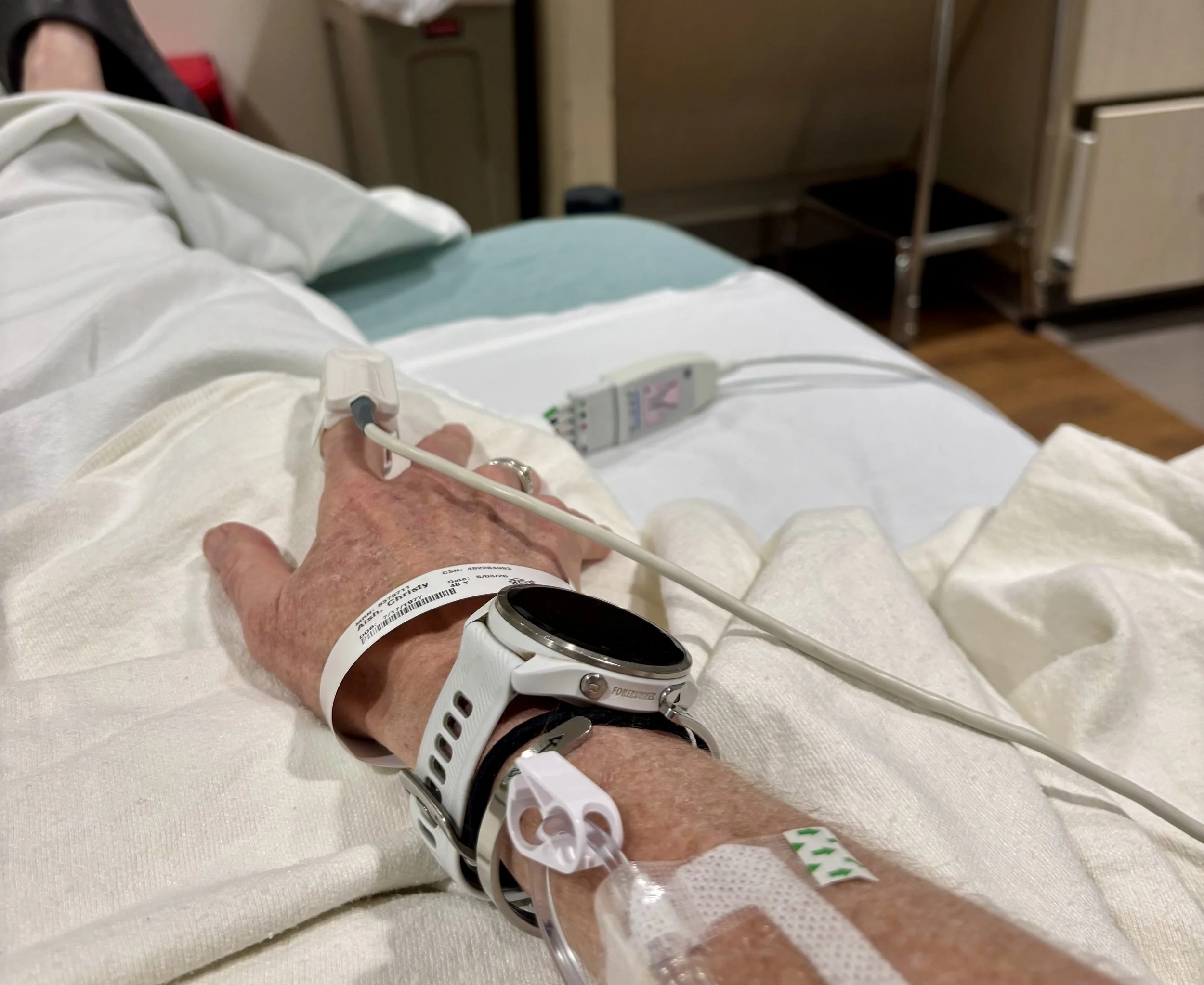
Thankfully, my EKG and chest CT scan were stable, though bloodwork was understandably all over the place. Since then, there have been multiple appointments—labs, scans, a stress test, an echocardiogram, and two weeks of wearing an event monitor while waiting for follow-up.
Some results have been reassuring, and I’m incredibly grateful that structurally everything appears normal. Many things are still uncertain. Even now, I can only exercise at a very mellow pace and have been instructed not to exercise alone.
Not an easy ask.
Endurance athletes live in a strange space with this stuff. Lower resting heart rates, high training loads, fatigue that becomes normalized, data that can look alarming outside of sport, but not always inside it. We spend years teaching ourselves how to override discomfort and push through hard things, which can make it difficult to know when something actually deserves attention.
And honestly, this has not been a peaceful journey of reflection.
There has also been irritability, anxiety, frustration, and a very strong urge to test things again—to jump on the treadmill “just once” and see what the numbers do. To look for certainty. To try to understand and find trust in a body that suddenly feels less predictable.
I’m working with these urges, and with the support of Mike, my friends, and family, I find myself needing daily surrender to this waiting. Sometimes I don’t listen very well, and stepping back is still a work in progress. If you are reading this and know me well, you are likely someone who has been in my corner, reminding me time and again of what really matters.
Endurance sport rewards the ability to keep going, but there are also times when that same trait can work against us.
What has helped most has not been answers, because there still aren’t many. It has been smaller things: stepping away from constant data checking when I can, continuing to move in ways that don’t have an outcome attached, conversations with people who understand endurance sport, and time with my kids, husband, and dogs.
Mother’s Day this year ended up being one of the best I’ve had in a while. A rare full Sunday with Mike and our teenagers, who are usually off with friends, and for an entire day, I didn’t think about running once.
When you take away something so central to your daily rhythm, it can feel like being thrown from a treadmill moving fast, suddenly not trusting the ground beneath you. We say it a lot in my field of work, but it's because it's true: grounding back to our values, what's most important, and letting go of things that we’re holding too tight is something I am continually working on.
The Unknown
This experience has made me think differently about the phrase “listen to your body.” Because it sounds simple, but in practice it really isn’t.
Sometimes there is clarity. Sometimes there isn’t. And sitting in that uncertainty has honestly been one of the hardest parts.
I no longer believe something catastrophic is happening, but I have temporarily lost some of the easy trust I’ve always had in my body as a runner. The place that has always felt most familiar suddenly feels more complicated. Even walking up a hill and seeing my heart rate climb to a place where I can barely get to on a tempo run is deeply confusing.
I still don’t fully know what this is. It’s clear it’s something I can’t just push through, and something I need to respect before returning to any level of training or intensity. More appointments await, and I am so lucky to be connected to people who will keep being there for me through it all.
To be continued... For now, I walk my dogs, hug my people, and know that this is just a chapter like all the others before and ahead. It really is just running, after all.
And maybe the hardest part about listening to your body as an endurance athlete is this: we spend years learning how not to listen to discomfort until suddenly we actually need to.
